
We tried to find a solution to how we searched for referral the need to develop mechanisms for refugees in Turkey!
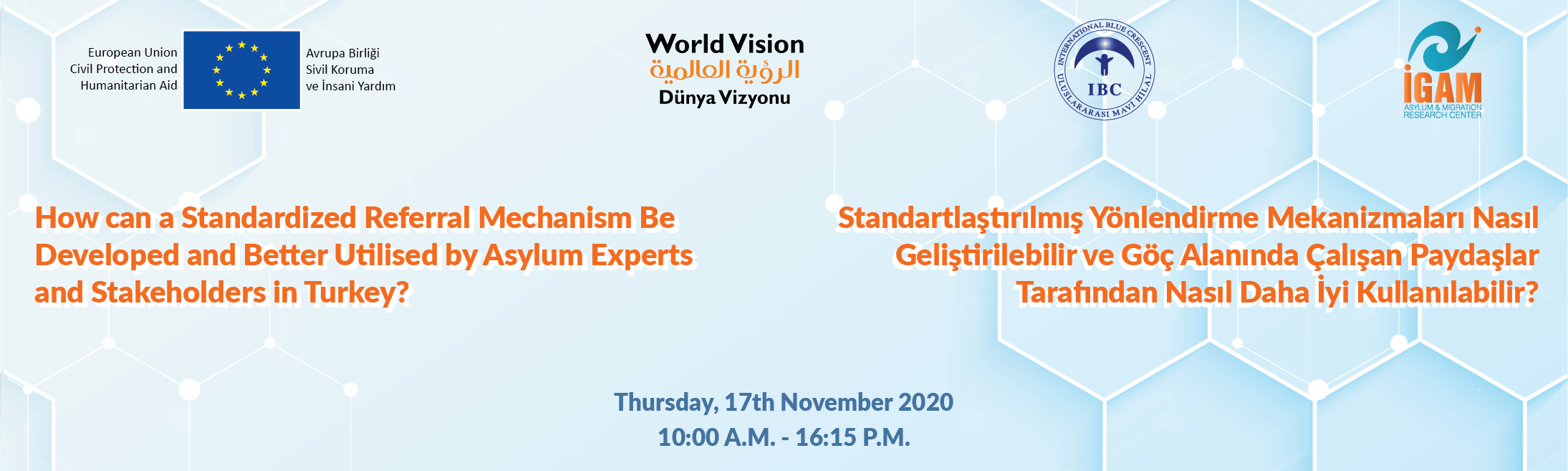
Conference on "How can a Standardized Referral Mechanism Be Developed and Better Utilized by Asylum Experts and Stakeholders in Turkey?
“Relations and coordination between public institutions and organizations and NGOs need to be strengthened!”
A conference which was held online on 17 November 2020, named “Standardized Referral Mechanism Be Developed and Better Utilized by Asylum Experts and Stakeholders in Turkey?” was performed under the partnership of the World Vision International, The Research Centre on Asylum and Migration (IGAM), and the International Blue Crescent Relief and Development Foundation with the contributions of the European Civil Protection and Humanitarian Aid Office (ECHO).
Christophe Gadrey, Technical Advisor of the ECHO, Eka Zhvania, World Vision Syria Emergency Response Director, İGAM President Metin Çorabatır, and IBC Program Coordinator Duygu Fendal made the opening speeches at the conference. The results of the Conference on Strengthening Routing Mechanisms Among Public Institutions and NGOs held on 8 November 2019 were discussed.
Answers to 3 basic questions were sought.
Then the participants split into six groups and discussed the answers to the following three questions:
- What were the main difficulties in the services provided due to COVID-19? How did your organization deal with these challenges?
- What needs to be improved in order to provide fast and high-quality guidance processes for the services offered by public institutions, NGOs, and other actors?
- How can the actors in the field strengthen the referrals made both in the virtual environment and physically?
After the lunch break, the group spokespeople shared the results of the topics they discussed with the participants.
The report containing the conference results that concluded with the closing speeches will be published as a booklet.
The relevant law should be revised!
İGAM President Metin Çorabatır shared the following views, stating that “NGOs’ work close to the community also fuels the issue of creativity”:
“NGOs are of great importance in making the voices and suggestions of the refugees heard. Making refugees’ voices heard also contributes to the welfare of Turkish society. Cooperation between public institutions and NGOs should be developed, and services should be standardized.
Conditions in the field of refugees have changed a lot. Many countries have renewed their laws regarding asylum seekers. Turkey should need to revise the law of “the Foreigners and International Protection Act” according to the needs of asylum seekers.”
The private sector should be included in the refugee field!
IBC (International Blue Crescent) Program Coordinator Duygu Fendal, on the other hand, stated that the private sector should be included in the issue in some way and said, “Covid-19 has increased the vulnerability of refugees, support requests have been raised very high. In this process, cooperation mechanisms should be considered as a complementary chain. Regarding the refugees, “The capacities of people in the field of protection need to be improved.”
Cooperation and coordination should be strengthened!
In group discussions with COVID-19, the change in many public institutions’ working hours and all organizations’ transition to an online working system has come to the forefront. Almost all participants agreed that the relations and coordination between NGOs and public institutions as well as public institutions and NGOs should be strengthened.
“Providing information and protection assistance to vulnerable refugees in Turkey and enhancing community-based protection” project is funded by European Union Civil Protection and Humanitarian Aid (ECHO).
This document covers humanitarian aid activities implemented with the financial assistance of the European Union. The views expressed herein should not be taken, in any way, to reflect the official opinion of the European Union, and the European Commission is not responsible for any use that may be made of the information it contains.
*This article was translated by Hale Özen who is a volunteer at IGAM'S MTE project.