
27.11.2020
İGAM Academy President and the Migration and Integration Research Centre's (TAGU) Director Prof. Dr M. Murat Erdoğan: "Anti-refugee sentiments may cause social conflicts."
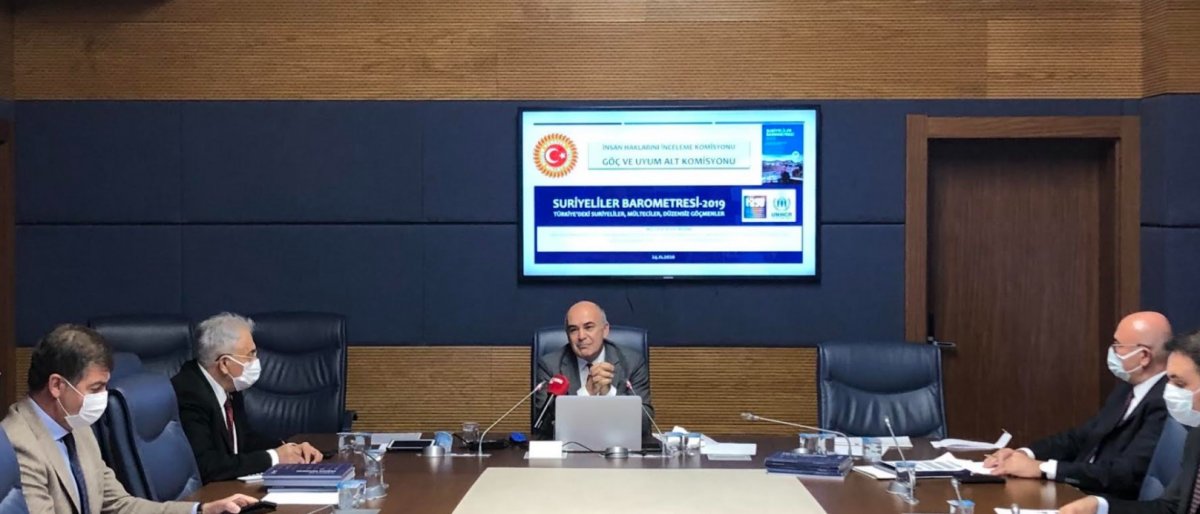
Prof. Dr M. Murat Erdoğan, who is the President of İGAM Academy and the Director of TAGU, shared the results of "Syrians Barometer 2019: A Framework for Achieving Social Cohesion with Syrians in Turkey" – the most comprehensive field-studies on the subject of Syrians in Turkey conducted simultaneously with the Turkish society and Syrians – with the members of the Grand National Assembly of Turkey's Parliamentary Subcommittee on Migration and Integration.
Evaluating the research findings at the Commission meeting held on Wednesday, November 25, Prof. Erdoğan stated that the majority of Turkish society is inclined to reject Syrians and opposed to social integration, and this reaction has caused Syrians to become ghettos, and, also, expressed his concern that a new nationalism against Turks will emerge.
Prof. Erdogan's evaluations are as follows:
Syrians are seen as a burden!
Anxiety, fear, and even hatred towards Syrians have been increasing day by day in Turkish society. The statement that Syrians, who were seen as victims in the early days, are now becoming a burden to society to a great extent. According to Barometer data, the rate of those who think that they are not culturally close to Syrians and say "we are not alike" has reached up to 82 percent. The social distance between Syrians and Turks is gradually widening. However, while such a negative opinion is dominant in Turkish society; the increasing welfare of Syrians also emerges as a striking element in the study.
We need to ease the tension within ourselves!
There is an asymmetrical transition between the two communities, and this is not a good omen. The risk of creating serious social ghettos in the future is very high. Turkish society already has a very fragile structure within itself. The more tense a society is in itself, the harder it is to accept who comes next. Therefore, if we are going to do something, we have to do it to ourselves first, and we need to reduce the tension within ourselves. For example, look at the crime rates in the first ten years of Turks migrating to Germany, or look at the second decade and the third decade; you will see crime rates are gradually increasing. In other words, unemployed, unprofessional, and uneducated young people can become aggressive by moving away from society after a while.
Despite everything, there is success in living together!
Syrians in Turkey have roots in Turkey, and there is no country that they can return to. There was a country where the Turks in Germany would have returned; however, they did not return, and they have been there for sixty years. A child who came to Turkey at the age of 12 will become 30's after ten years; so, where and how is it possible for them to return? So, we need to come to a more realistic point. Currently, we have been living together, and the rate of the camps is not even 1 percent. So actually, there is a success in living together, and even this is a miracle; since more desperate situations could arise, and violent clashes between the two communities could occur. I think that the Anatolian people have behaved very thoughtfully in that respect.
They do not believe that they will live in peace with Syrians!
90 percent of the population now believes that at least half of the Syrians will stay in Turkey. When asked, "Can we live together with Syrians in peace?", 75 percent of them clearly say "no". 87 percent of the society refuses to give political rights to Syrians. In the analysis regarding the political parties, even the AKP members, around 80 percent, say "political rights should not be given". The biggest support given to Syrians comes from HDP as a political party. AKP and HDP are on the one hand; MHP, CHP, and İYİ Party are on the other hand. When we ask, "How would you rank the priority of the issue of Syrians?", it turns out to be 3.3 on average. According to the 27 percent of the Turkish society, Turkey's most crucial problem is Syrians. In any case, Turkish society considers the issue of Syrians as one of its top 3 issues.
*This article was translated by Beril Cansın Saran, an intern at IGAM, and edited by Hale Özen, a volunteer at IGAM's MTE Project.